
Today I have another friend coming out with a new book: Ultraproductive!
I’m doing a bit of time travel right now. As I write this, it is September 28th and Ardyn is due in six days. Ultraproductive is a fitting book to cover right now, as I look ahead to how I can manage my time, attention, and energy when baby girl is here. We’re so excited. And for managing these ingredients of productivity, this book has helped me a lot.
Enjoy the conversation!
- One thing I appreciated is that the book doesn’t treat productivity as purely a work problem. Focus, rest, and stress affect our relationships and how present we are outside of work, too. When people begin using this method, where do you tend to see the biggest unexpected benefit outside their professional lives?
Our book is all about doing your best work without sacrificing what matters most in life. Our passion for this idea started when hustle culture brought us both to our breaking points, and each of us had a health scare. My co-author Eric Partaker had a heart attack on a plane at 36,000 feet when he was just 36, and I came close to burnout when my first company failed. Those experiences taught us that focus, rest, and stress work like a three-legged stool. Fractured focus amplifies stress, a lack of rest erodes focus, and poor stress management disrupts sleep. Take away one leg, and no matter how strong the other two are, you’ll fall over. Get all three right, and you’ll do your best work while also protecting your physical health, mental health, and relationships. - You make the case that stress itself isn’t the enemy. It’s staying activated without recovery that creates the problem. What are some of the earliest signs that useful acute stress is beginning to turn into harmful chronic stress?
As Stanford psychologist Kelly McGonigal puts it, stress arises when something you care about is at stake. Many of the most meaningful things in life—building a career, creating a thriving partnership, raising kids—come with stress. The goal isn’t to eliminate it. It’s to recover from it. Stress starts becoming a problem when we stay activated and never come back down. One of the earliest warning signs often shows up in your sleep. If you suddenly struggle to fall asleep, wake more often, or stop feeling restored in the morning, that’s a signal that your nervous system may not be switching off properly anymore. - You argue that rest isn’t something we earn after being productive. It’s actually part of what makes high performance possible. What happens physiologically or cognitively when we keep pushing through the signals that tell us we need a break?
Our brains begin to tire after about 90 minutes of intense mental effort. That’s part of our natural ultradian rhythm, and it’s often the moment our body asks for a break. If we push through, our prefrontal cortex—the “CEO” of our brain—becomes less effective, so work feels harder and delivers weaker results. To compensate, the nervous system can shift further toward the sympathetic, fight-or-flight branch to supply extra energy. The result is that we’re using stress to compensate for fatigue. Concentration gradually deteriorates, while we may still feel wired enough to keep going. And if we repeat that pattern all day, we can carry that activation into the evening, leaving us overstimulated when it’s finally time to sleep. - You write, essentially, that if you want to go fast, you need great brakes. What are the “brakes” that high performers tend to neglect most, during the workday, at night, or across an entire year?
Your nervous system works like a race car. The sympathetic branch is the accelerator, driving alertness and action. The parasympathetic branch is the brake, slowing you down and restoring calm. If you want to go fast in life without ending up in a crash (i.e. burnout) or having to slow down to a crawl, you want to use that brake on different timescales. During the day, take a short break every 60 to 90 minutes. At the end of the day, have a shutdown ritual. At night, get plenty of sleep—the ultimate brake—and protect both your deep and REM sleep. Across the year, take a week off every quarter instead of saving everything for one big annual vacation. The infographic below shows seven breaks to avoid burnout, from a 10-second breathing reset to a quarterly vacation. - Chris has a baby arriving in the next week, so the section on sleep for new parents suddenly feels very relevant. Your book says sleep optimization isn’t about perfection and that, after a bad night, maintaining your rhythm can sometimes matter more than trying to aggressively “catch up.” When you have a newborn and disrupted sleep is unavoidable, what should a new parent realistically prioritize, and what should we just let go of for a while?
Congratulations, Chris. I’m so happy for you. Having kids is the best thing ever. And yes, for a while, sleep gets messy. That’s okay. The goal isn’t perfect sleep. It’s getting the best recovery you realistically can. With two little ones of my own, aged 1 and 2, here are the three things that have helped us most. First, become a pro napper. Naps are the lifeblood of any new parent. A power nap lowers your sleep pressure and gives you something like a second morning, while a longer, 90-minute nap can give you the chance to move through a full sleep cycle. Follow the old advice to sleep when your baby sleeps, and aim for at least one nap a day. If you’re not a napper, try non-sleep deep rest (NSDR, such as Yoga Nidra) instead. Second, breathe. Soothing a crying baby back to sleep for the better part of an hour is one of the most draining parts of parenthood. You’re exhausted, it’s dark, and every minute feels longer than the last. But you can turn that moment into a recovery practice of your own. While you make the familiar “shhh” sound, stretch each one into a long, full exhale and empty your lungs completely before you breathe in again. Extended exhales help shift your nervous system toward its parasympathetic, calming state, so the sound that calms your baby calms you too. I’ve found this works incredibly well. Third, be a team. If neither parent ever gets high-quality rest, everyone suffers. Taking turns on night duty is far more sustainable than both of you being half-awake every night. The parent who is off duty should protect that time ruthlessly, with earplugs and a blackout mask to maximize deep sleep. The parent on duty knows their partner will come back with more patience and energy. If needed, consider a “sleep divorce”: sleeping in separate rooms and alternating nights. It may feel unromantic, but protecting each other’s rest is one of the most loving choices you can make. And perhaps most importantly: let go of perfection. A newborn is not the season for optimizing every sleep metric. Protect your rhythm where you can, recover whenever the opportunity appears, and trust that this phase will pass.
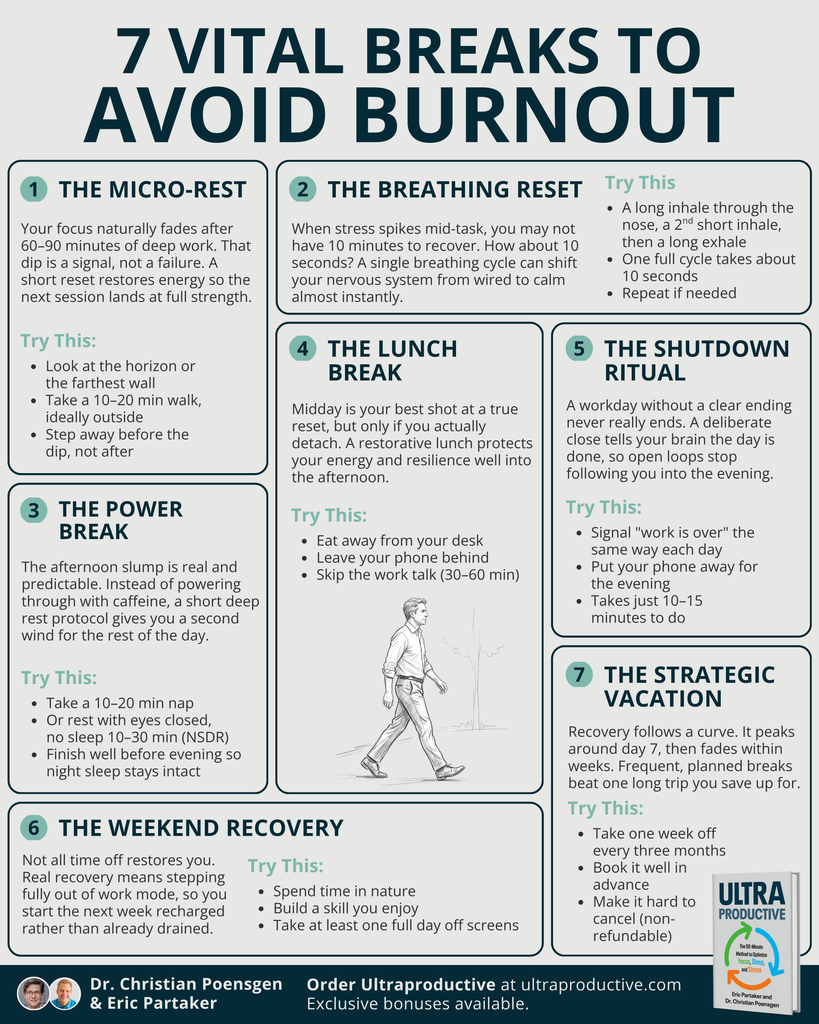
P.S. The infographic above is one of the 9 that come free with Ultraproductive. Order the book and all 9 are yours today. The first 10,000 people who order the book also get a free seat in Eric and Christian’s live Accelerator program (regular price $993). Secure yours here.
Thanks so much again to Christian for coming on for a Q&A! You can order the book directly, here. Thanks, Christian 🙂