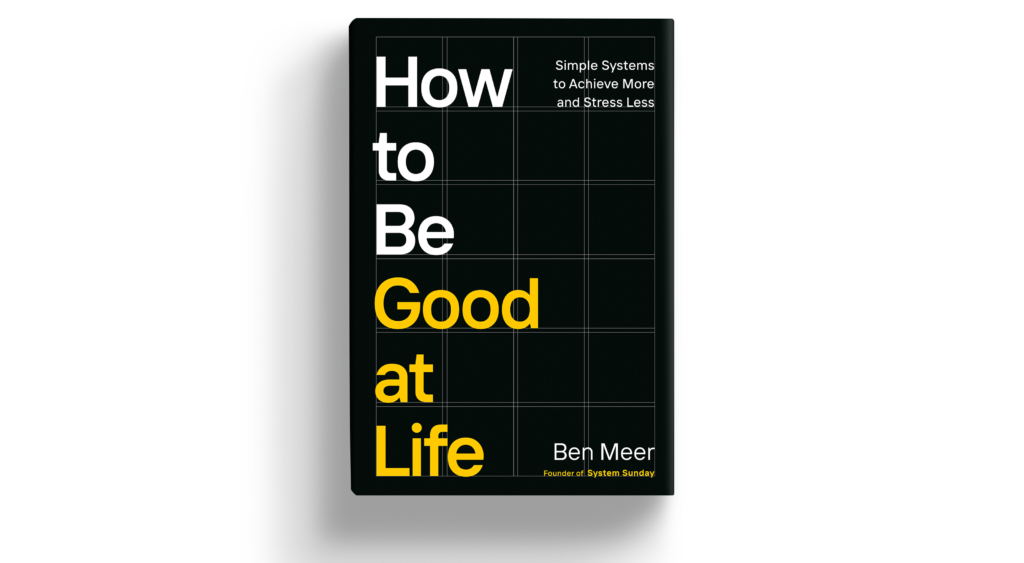
My friend Ben Meer has spent years thinking about a question I’m endlessly fascinated by: How do we make the important parts of life run a little better without turning life into one giant optimization project?
His answer is systems—simple structures that reduce friction, make good choices easier, and help us follow through on what matters.
We chatted about where habits fall short, how to define a productive day, why knowledge workers should think like mental athletes, and the weekly practice Ben uses to make life progressively easier.
Here’s our conversation!
1. Your book is called How to Be Good at Life. What does being “good at life” actually mean to you?
Being good at life is systematizing things today so tomorrow is a little easier and lighter.
Sometimes it’s as simple as writing down a friend’s birthday. The calendar reminder pops up, you reach out, and a tiny system helps you be the kind of friend you want to be. That’s the whole idea in miniature.
It could also look like keeping a running gift list so when something comes up in conversation, you jot it down and you’re not scrambling during the holidays. Or maybe you automate your savings—even if it’s a little bit—so your future self has more security.
And the part that surprised me is what those small systems give you back. Stack enough small wins and something else shows up: quiet confidence. You start trusting that whatever life throws at you, you can figure it out.
That’s the real gift of systems. Not just being better at life, but feeling good at life.
2. Habits have become one of the dominant ways we think about self-improvement. Where do habits fit—and when do you need something more?
I love habits. I just think we’ve been oversold a little bit on what they can do.
A habit is a behavior you do almost automatically—think brushing your teeth. That’s incredibly useful because it makes it easier to do important things with less cognitive strain.
Research suggests that around 40% of what we do each day is habitual. That’s a huge help. But it also means the majority of what we do isn’t—and a lot of it never will be.
Some of our biggest creative projects, our most important strategic work, even our relationship dynamics can’t become habits. They either have too many steps or happen too infrequently to ever become automatic.
And the problem is, people get down on themselves because they’ve been told everything should become a habit.
Habits are just one tool in a broader systems toolkit. A checklist is another. Before I had a travel packing checklist, I once forgot pants. Since using one, my legs have been consistently clothed.
Other problems call for a project. You define the outcome, break it into milestones, then turn those milestones into concrete tasks. If you’re renovating a kitchen or trying to land your dream job, that structure gives you a path through the complexity. You can’t habit your way through it.
So I’m not saying we should give up on habits. We just need to expand our systems toolkit. The more tools we have, the easier it becomes to navigate a complex world.
3. You have a weekly practice called “System Sunday.” What is it, and why can a small investment of time on Sunday make the rest of the week run so much better?
I started System Sunday because I used to get the Sunday scaries.
Sunday afternoon would roll around, and suddenly every meeting, errand, and loose end from the week ahead would start running through my head.
What I eventually realized was that a lot of that anxiety was simply my brain asking for a plan.
So I started carving out 30 to 60 minutes on Sunday to get clear on what actually matters that week and schedule those priorities on my calendar.
It also lets me spot friction—like a double booking or four hours of meetings with no break—and make adjustments before the week begins.
And if you want to take it a step further, use part of System Sunday to set up one simple system that makes your life easier going forward.
Maybe it’s putting your phone in grayscale, which turns it from a slot machine into a boring gray rectangle. One study found people using grayscale spent about 40 fewer minutes a day on their phones. That’s 10 full days a year.
Imagine that once a week, you remove one recurring frustration, automate one repeated task, or make one good behavior easier. After a month, you have four improvements working for you. After a year, you have dozens.
So rather than trying to redesign your whole life this weekend, pick one thing. Make it easier. Then come back next week and do it again.
4. A lot of ambitious people feel like no matter how much they accomplish, it’s never enough. How do you decide what a productive day actually looks like?
I use something called the 3-3-3 Method, which comes from Oliver Burkeman: three hours on your most important project, three shorter tasks, and three maintenance activities.
I love it because it solves a problem a lot of ambitious people have: no matter how much you get done, it never quite feels like enough.
You could cure cancer before lunch and your brain would still go, “Yeah, but did you answer Greg’s Slack message?”
Part of the reason is structural. In the industrial era, “done” was obvious. Your shift ended. The mail route was finished.
But in knowledge work, there’s no natural finish line. There’s always another email, another idea, another useful thing you could do. The goalposts keep moving because we never planted them in the first place.
The 3-3-3 Method gives you that finish line.
For me, the first three is three hours on my most important project. Then three shorter tasks—calls, feedback, reviewing something. Then three maintenance activities that keep work and life running. Think processing email, doing laundry, or prepping meals.
And that first three matters most. Show me someone who consistently spends three hours a day on their most important work, and in a few years I’ll show you what everyone else calls an overnight success.
When I hit my 3-3-3, I can close the laptop guilt-free. I’ve done enough for today.
You can tune the numbers to your life. A parent with a newborn might only have one hour for their most important work. The exact numbers matter less than the principle:
Define “enough” before the day begins, then let yourself feel satisfied when you reach it.
5. You argue that knowledge workers should think of themselves as “mental athletes.” What does that mean in practice?
Most people treat productivity as a time-management problem. But I actually think energy management is even more important.
Because what good is having the time to do something if you don’t have the energy to do it well?
For knowledge workers, almost everything is downstream of brain health. Peter Drucker has this great line: “The bottleneck is always at the top of the bottle.” For us, the top of the bottle is between our ears.
So if you think for a living, I think you should start treating yourself like a mental athlete.
Here are a few things to prioritize:
Stay hydrated. I like to take an “internal shower” every morning by drinking a full glass of water as soon as I wake up, then keeping a water bottle nearby throughout the day.
Avoid routinely eating yourself into a food coma. I like the Japanese principle hara hachi bu: stop eating when you’re about 80 percent full—satisfied, but not stuffed.
And try to stop defaulting to sitting. Take a walking meeting. Use a standing desk. Look for easy ways to put more movement back into a day that might otherwise happen almost entirely in a chair.
None of this is particularly glamorous. But we spend so much time optimizing our calendars while ignoring the person who has to perform inside that calendar.
6. If someone takes only one idea from How to Be Good at Life, what do you hope they remember?
If life feels harder than it should in a particular area, get curious about the system underneath it.
As physician Paul Batalden put it, every system is perfectly designed to get the results it gets.
So if something isn’t working, it’s tempting to ask, “What’s wrong with me?” A better question is: “What system is producing this result?”
Say you’re exhausted all the time. The self-blaming interpretation is, “I’m terrible at sleep.” But maybe your phone lives on your nightstand, so you end up scrolling for 45 minutes longer than you intended, staying up later than you want, and cutting into your sleep.
Once you see that, you can charge your phone in another room and buy a ten-dollar alarm clock to replace it. Or use a tool like Brick to disable distracting apps in the bedroom.
Suddenly, what you thought was a character problem becomes a design opportunity.
That’s the shift I hope people take from the book. Instead of immediately getting down on yourself, get curious about the structure underneath the outcome.
Once you can see the system, you can redesign it. And that’s where real transformation becomes possible.
—
Thanks so much again to Ben for coming on the newsletter for a Q&A! When you order his book, you get his course for free—that offer is here! You can also order the book directly, here. Thanks, Ben 🙂