
You can only choose one. For life.
Every pill hides one of your values.
You just met one of your 12 values. Intentional goes deep on all twelve.
Get the book → Or rank all twelve with the Values Test →The key to finishing what you start is becoming more intentional.
Does this sound familiar?
Instead of marketing my book to you, let me let you read some of it. (No time to read this? Then you may need the book even more.)
Not every goal that feels or sounds right will prove worthwhile. […] We fall in love with the idea of a goal, pushing out of mind how different our day-to-day will need to be for us to make it happen. […]
To illustrate this, there’s one goal that immediately comes to mind: to wake up at 5:30 every morning. This is an intention I’ve set for myself multiple times over the years—I absolutely love the idea of it. […] Every time I try this, I find that I have constructed some beautiful, sepia-toned fantasy of how my days will be different. I imagine waking up—before the sun and the rest of the world—to make a hot p. 83cup of coffee, read the newspaper, and get a morning burst of exercise in. I imagine getting to inbox zero before everyone I know even wakes up. (Wow, this guy is so productive! they will think.)
In the morning, I need whatever is the mental equivalent of a spatula to pry myself out of bed, because 5:30 a.m. is well before my body wants to get up. […] As my mushy morning brain has put it as I’ve stared at the ceiling at 5:31: This goal is stupid and it sucks.
Sometimes, you might achieve your idealized goal and realize it’s not truly the way you want to live, that your ideal does not match your reality. I still remember the first time I finally managed to become an early riser. I had built the perfect morning routine, the one that sepia-toned productivity fantasies are made of. I woke up at 5:30 and did all the things I mentioned: drank a cup of coffee, read the paper, and meditated. I worked out, caught up on email, and was otherwise productive. Unfortunately, I still hated the ritual—it did not live up to the fantasy whatsoever. Not even close.
What you walk away with.
Intention is not just for accomplishing more—it is for accomplishing more of what you want. Here's some of what you'll get out of the book.
A short list of goals that are actually yours.
The goal inventory and the values edit: which goals to keep, which to reframe, and which to drop without guilt.
You'll stop avoiding boring, frustrating, and unpleasant work.
Six characteristics of aversion, a remedy for each. (Counterintuitively, boring work usually isn't too hard—it isn't challenging enough.)
A way to follow through on the long, far-off goals.
Time discounting, desire curves, and the pace line: a target pace instead of a deadline you'll blow.
Real progress.
Outcome goal, process goals, rate of progress—the three-part template every goal in the book gets.
Know which goals to drop.
"Just because a goal is a struggle doesn't mean that it isn't worthwhile."
Learn from my weird experiments.
I run the experiments on myself first. Three of them, straight from the book—and what each one turned into.
Fit points
A few years back, I set a new postpandemic goal for myself: to lose enough weight to get to 15 percent body fat. (My pandemic experience involved a lot of takeout.) […]
Read the passage
I worked this new goal into a structure I already had in my life: our nerdy joint budget spreadsheet. […] Make it so I had to “unlock” my personal budget by following through with my fitness goals. […]
This new system, on the other hand, was built around structure—and better yet, it was tied to an existing structure in my life, my personal budget. If I wanted to do so much as grab coffee with a friend or try a monthly Japanese snack subscription box, I had to do the work and unlock the money first. As the experiment went on, I introduced penalties with Ardyn for my not following through with my goals, like paying her a fine if I didn’t follow the system. (She loved this.)
Ten days in the basement
For a period of ten days, I lived in our basement, where I had zero exposure to sunlight—and, more crucial, no exposure to other people. […]
Read the passage
And the first couple days were indeed superproductive—no surprise, there were zero distractions and interruptions to derail my time and attention. […] But then, a few days in, the honeymoon period faded. […]
Down in the basement I had a laptop, food, bed, and a dehumidifier that I named Danby, who I became fast friends with. But there were no people. […] Oddly, tasks that I typically loved doing became significantly more aversive.
In the basement, I had zero opportunity to invest in any of these social values, which made my level of motivation plummet.
The marathon I trained for and never ran
So, with the full length of a marathon easily in my sights, I did what most people probably wouldn’t: I stopped training entirely.
Read the passage
I didn’t give up. At that point, feeling as though I could have run one was more than enough for me. If you value achievement, you are probably feeling completely baffled by this sentiment. […]
At the end of the day, this is what success really is: being true to who we are on a fundamental level.
Four things you can try tonight.
Each one is usable the same day, and each one is in the book exactly as it appears here.
The Rule of Three
The ritual is called the rule of three. First, you pick a time frame—like each day, or the week or month ahead. Then, you put yourself in the shoes of your future self and ask: By the time this day is done, what three things will I want to have accomplished? That’s it. The rule works just as well every week, month, quarter, and year. You name the timeline, and the rule will help you reflect across it.
Trip wires
For hedonism, maybe you have the habit of staying up late to watch TV. As a trip wire, you can put a large plant in front of the TV that you’ll have to move if you want to watch. This might help you pause long enough to consider how watching TV fits with everything you’re trying to accomplish. Or, if you tend to impulsively buy things online, you can try removing the saved credit cards from your phone, so you have to (annoyingly) manually enter the numbers when you want to buy something.
Values days
You can have a values day whenever it makes the most sense for you and your routine. It doesn’t even have to be a day. If the most you can muster is a half day, even an hour, that’s fine. But when you have to do something that goes against your top values, take some time to do what is congruent with your topmost values; deliberately spend time on what you find most meaningful.
Intentional indulgence
When I saw that I had an evening free of plans, I made sure to block off the time in my schedule—not so someone wouldn’t book a random evening meeting with me but so I could get excited about that evening when I looked through my calendar for the week. Sometimes, I’d build a small list of what I wanted to watch, listen to, and eat. If an exciting episode of a podcast dropped, I’d save it for that evening.
The part of the book that is about you.
All day long, we make decisions that we can't explain. Your values are at play behind the curtain, pulling the strings. The test lets you finally peek behind it.
Answer 57 questions and get a gorgeous lifelong keepsake: a wheel of your twelve core values, ranked—from the most scientifically-validated values assessment in the world. Most people end up sending theirs to someone they love.
Find out what actually drives you — $25 →~10 minutes · works on any device · built on 40+ years of research
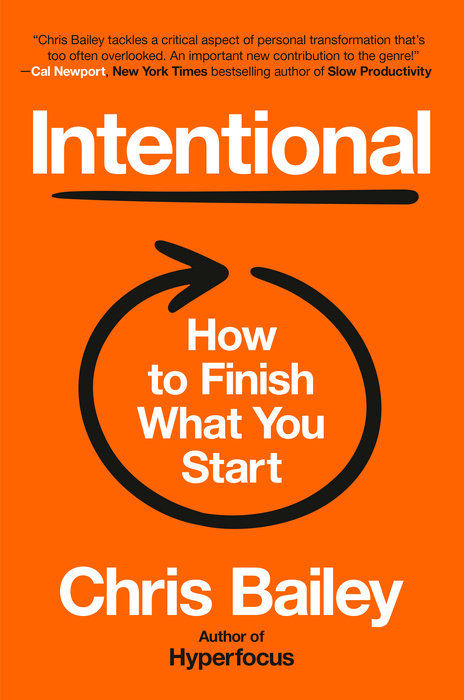
A powerful guide to turning ambition into action—by focusing not on willpower but on what matters most.
A look inside.


304 pages · Hardcover · eBook · Audiobook
Chris Bailey tackles a critical aspect of personal transformation that's too often overlooked. An important new contribution to the genre!

A refreshing, counter-intuitive approach to productivity that cuts through the noise and actually helps us accomplish our goals. Spoiler: thankfully, it's not about willpower.

Intentional shines a light on the hidden architecture of follow-through, offering rituals and simple practices that align today's choices with long-term meaning. When you can finish what you start, your work and life feel more purposeful.

In Intentional, Chris Bailey offers a clear, engaging guide to following through with purpose—whether you're tackling everyday tasks or striving for deeper fulfillment.

A must read! Bailey does a masterful job providing a road map for anyone who has ever wanted to reach a goal and be confident of how they got there.

In a world obsessed with more, Chris Bailey reminds us that success is not about doing everything, but about doing the right things with purpose. This isn't just a book about productivity—it's a blueprint for living a more meaningful life.

A masterclass in harnessing intention to drive action—practical, insightful, and deeply human. Read this book, and you'll never struggle to achieve your goals again.

[Intentional] offers both scientific insight and everyday strategies for becoming more intentional in work and life.

Desires are one thing. Making them happen is another. Fortunately, Chris is here with gentle and insightful tips to help you achieve what you set out to accomplish. Highly recommended for anyone who has big goals and wants the best possible chance of making them come true.

Get the book.
Hardcover, eBook, or audiobook—choose your country, choose your retailer.
Resources.
Here are the resources I mention in Intentional.
Get my newsletter!
If you want even more tips for becoming more intentional in this world of distraction, sign up here!
No spam, ever. Always free!
So step back and choose where to go. You won't just follow through and attain more of your goals. You'll also experience more meaning as you do.
My hope is that along the way you can appreciate not only who you are becoming but also, and far more important, the wonder of who you already are.