
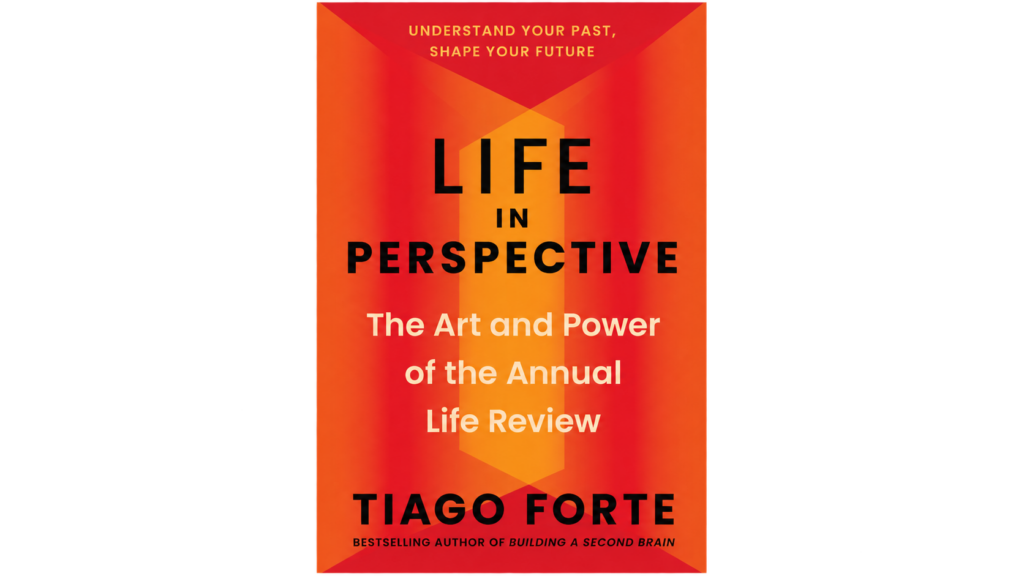
- You’ve spent years helping people become more productive. In Life in Perspective, you explore how we decide what deserves our effort in the first place. What has changed most about your own definition of a productive life?
I’ve done productivity coaching for years, but looking back on all those hundreds of interactions, I can only conclude that the execution or “how” of what all those people were doing mattered much less than the selection of what to go after in the first place, and crucially, why.
I’ve found that achievement-oriented people are so capable that they tend to skip over the “why” completely because it’s ambiguous and uncomfortable, whereas the “how” is clear and concrete. I totally get this, but I think occasionally, such as once per year, it’s so important to step back from the doing and reconsider your life direction in light of what’s changed. And how YOU have changed. That’s what Life in Perspective is a guide for – how to do that in a structured and intentional way. - You describe rereading your 2013 annual review and finding harsh criticism of yourself during a year when you’d managed to support yourself as a new freelancer. What helped you stop using reflection to punish yourself—and did becoming kinder to yourself change what you accomplished?
I’ve found that a lot of capable, smart people have a terrible relationship with their “inner voice.” They may perform well on the outside, but on the inside they are telling themselves things like “You can’t mess up” or “Get this right,” and then beating themselves up with harsh, judgmental words when they invariably do mess up, like all humans.
Long term, the cost of this is that you can’t relax or enjoy the fruits of your labor, even within the confines of your own head. It’s never enough, never good enough, never impressive enough. I’m so thankful I found a way out of that trap of self-judgment, and conducting annual reviews in which I repeatedly looked at everything that was good and worthy in my life was a key tool I used to do so. Gratitude is the ultimate antidote to self-judgment, which is why I put it front and center as the starting point of the review. - One of your more surprising suggestions is to get curious about envy. You describe reading an essay that made you realize you wanted to invest more in your wife’s personal growth. How can we tell when envy is revealing something we truly value, and when we’re getting caught up in someone else’s idea of success?
One of my greatest lessons has been that every emotion, and I mean EVERY emotion, is valuable and has something important to tell us. Our culture tends to treat certain emotions as “good” and others as “bad,” such as anger, disappointment, envy, helplessness, fear, and shame. But I think rather than denying or avoiding such emotions, which only tends to make them cry out louder, it’s healthier to ask of them what they are trying to tell you. Envy, in this case, points to what you want and are currently missing. And not from an intellectual, rational point of view, but a visceral one, arising from deep in your gut, which is also where feelings like happiness and fulfillment arise from. My advice in Life in Perspective is to allow envy to say what it has to say, and write it down so you can see it through different lenses. - You encourage people to pay attention to bodily signals when considering a commitment. But a meaningful opportunity can feel frightening, and an unhealthy pattern can feel comfortable. How do you interpret those signals when fear and excitement feel similar?
This is such a great question! And it’s true – sometimes your bodily sensations are pointing in exactly the WRONG direction. That’s why as part of the annual review I advise listening to multiple sources of information, never just one. The trick I think is to treat the interpretation of those bodily sensations as a skill that you can develop over time.
There are many ways of doing so, and a lot of research that this is feasible, but in my book, the method I recommend is to simply write down the thoughts and feelings that arose when making a decision, and then seeing how that decision turned out! The record of your annual reviews stretching out over the years is a fantastic body of evidence to look back on and analyze for recurring patterns in your thinking, and what regularly leads you astray. - After moving to Mexico City, you realized that many of your goals were attempts to make up for things you hadn’t done in your previous life. How can we recognize a goal we’ve outgrown, especially when letting it go feels like admitting defeat?
I’ve found that many people’s goals emerge from somewhere other than pure desire. They come from wanting to please their parents, or to look prestigious for their peers, or from fear of not having enough, or to gain the security they lacked as children.
There’s nothing wrong with any of this, but I believe the most powerful goals, and the ones most likely to succeed, come from a deep, unfiltered, almost childlike place within you. A place of true desire, unclouded by others’ expectations or your own fears.
A big part of the annual review is to uncover all the layers and the filters we’ve put in place, often as part of our adult or professional responsibilities, to answer that timeless yet difficult question: what do you truly want? I’ve never been able to answer that question straightaway, in one shot. It takes some time digging deep, examining the events of my past year, and journaling and meditating on what’s alive in me in the present, before I can finally arrive at an answer that feels true and real.
—
Thanks so much again to Tiago for the Q&A! You can order the book directly, here. Thanks, Tiago 🙂