
“Automations” are a myth. Wait long enough, and yours will break. It’s almost guaranteed. And at that point, they’re no longer automated. They’re something you have to debug and fix.
For this reason, everything that looks like an automation is really just a system that works—for now.
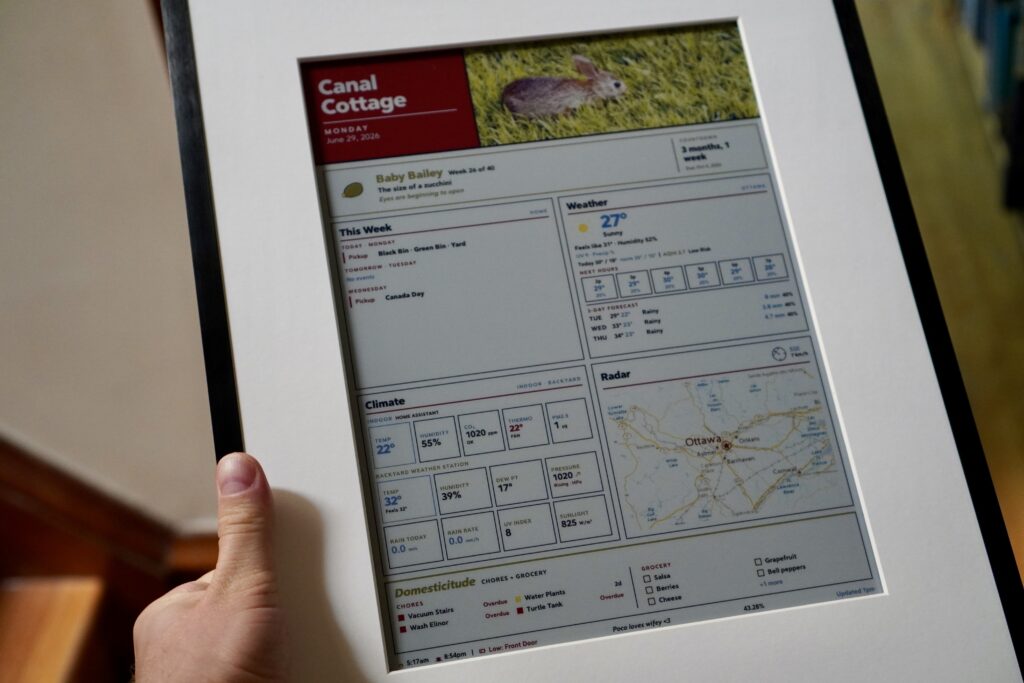
For example: in our hallway, we have a beautiful e-ink frame. I used Claude to program it to update every hour. As you can see above, it pulls from multiple sources: household chores from an Apple Note, weather radar from Environment Canada, conditions from our backyard weather station and Home Assistant, and more.
The problem? It breaks constantly. Our joint Google Calendar disconnects, and I have to go back into Claude to set it up again. (It’s broken in the image above, in fact!) The house data sometimes goes blank whenever our internet hiccups. It feels like every part of it has broken at some point. (I don’t care, it’s a fun hobby. I look forward to fixing it the next time it malfunctions.)
It’s not a bad thing that every automation eventually breaks. It’s just worth knowing before you build one.
A few tips I’ve found helpful:
- Guess at where your automation will break—and the costs of it breaking. This isn’t always possible to know. But start with the foundation it’s built on. My home dashboard integrates about 10 services and breaks constantly, but I’m okay with this—programming it has been a tinkery hobby. But if it’s mission-critical, look hard at each component and the odds it’ll fail. Know the costs and the risks.
- Make breakage loud! A silent failure is the dangerous kind. So I keep a bit of “Last Updated” text on the dashboard—when it goes stale, I can spot the break at a glance. It’s also easy to spot when sections of the dashboard don’t update. You never want to discover a break by accident.
- Mind how annoying it’ll be to fix. There isn’t much friction to updating my dashboard—I just ask Claude when I get a chance, either directly or through the Dispatch feature (which lets me message Claude on my desktop from my phone). To me this is relatively frictionless. But if a fix means real work—like digging up an automated backyard sprinkler—question the foundation, and maybe simplify. Fewer moving parts means less can go wrong.
So automate away—but remember what you’re building. Not a machine that runs forever, but a system that works… for now.